MentalHealthCE Login


| Login | ||

Healthcare Training Institute - Quality Education since 1979
CE for Psychologist, Social Worker, Counselor, & MFT!!

Section 4
Chapter-by-Chapter Comparative Analysis
and Diagnostic Transitions
Question 4 | Test | Table of Contents
The shift from DSM-5 to the new framework fundamentally alters the internal mechanics of major diagnostic chapters [Future DSM Committee, 2025]. Below is an exhaustive analytical comparison of these operational criteria shifts.

4.1 Neurodevelopmental Disorders
The neurodevelopmental chapter has transitioned from a childhood-centric model to a lifespan-developmental model, backed by structural refinements in criteria execution [Lord et al., 2022].
Autism Spectrum Disorder (ASD)
- DSM-5 / DSM-5-TR Formulation: ASD consolidated multiple historical subcategories into a single spectrum defined across two domains (Social Communication and Restricted/Repetitive Behaviors) [APA, 2013]. However, the application of severity specifiers was frequently combined or applied globally to the overall diagnosis, creating significant diagnostic ambiguity for insurance providers and school psychologists [Lord et al., 2022].
- New Scientific Framework Modification: The leadership issued a critical structural clarification, dictating that the severity specifiers for Criterion A (social communication) and Criterion B (restricted, repetitive behaviors) must be evaluated and coded completely separately, rather than as a single entity [APA Neurodevelopmental Panel Guidance, 2025]. This structural decoupling forces psychologists to provide a dual-track severity profile:

This decoupling prevents the masking of severe behavioral rigidities in individuals who possess high verbal or social compensation strategies [Lord et al., 2022].
Attention-Deficit/Hyperactivity Disorder (ADHD)
- DSM-5 Formulation: Lowered the adult symptom threshold to 5 symptoms and raised the impairment onset criteria to age 12 [APA, 2013]. However, it still required the presentation of a specific subtype.
- New Scientific Framework Modification: Subtypes are fully deprecated in favor of a fluid, transdiagnostic dimensional tracking system housed in Domain 4 [Future DSM Committee, 2025]. The core diagnosis in Domain 3 focuses strictly on the persistent developmental impairment, while the unique phenotypic expression (e.g., executive processing deficits, working memory capacity, behavioral impulsivity) is continuously mapped via Domain 2 neuropsychological endophenotypes and Domain 4 dimensional metrics [Barkley et al., 2024].
4.2 Neurocognitive Disorders (NCD)
The neurocognitive chapter has completely aligned its criteria with precise, objective neuropsychological performance metrics, removing the last vestiges of subjective clinical impressions [Neuropsychology Harmonization Project, 2025].
- DSM-5 Formulation: Bifurcated cognitive decline into Major and Mild NCD based on whether the cognitive deficits interfered with independence in daily activities [APA, 2013]. Psychometric thresholds were described loosely as "substantial" or "modest" decline.
- New Scientific Framework Modification: The distinction between Major and Mild NCD is now strictly calibrated to rigorous psychometric standard deviations (SD) derived from validated, age- and education-normed neuropsychological testing batteries, operating alongside an independent, quantified assessment of functional activities of daily living (ADL) [Neuropsychology Harmonization Project, 2025]:

This clear demarcation prevents diagnostic inflation and provides neuropsychologists with an objective, universally reliable framework for tracking degenerative progression [Neuropsychology Harmonization Project, 2025].
4.3 Personality Disorders: The Deprecation of Section II
The most significant paradigm shift for practicing clinical psychologists is the official deprecation of the traditional, categorical Section II personality disorder clusters (Clusters A, B, and C) [Somma et al., 2024].
- DSM-5 Framework: Retained the ten traditional, overlapping categorical diagnoses in Section II due to clinical inertia, while placing the Alternative Model for Personality Disorders (AMPD) in Section III as an experimental framework [Skodol et al., 2015].
- New Scientific Framework Modification: The traditional categorical model is moved to historical status [Alternative Model for Personality Disorders (AMPD) Implementation Task Force, 2025]. The Alternative Model for Personality Disorders (AMPD) is now fully operationalized as the primary diagnostic vehicle [Somma et al., 2024]. Personality pathology is evaluated through a hybrid dimensional-trait architecture [Somma et al., 2024]:
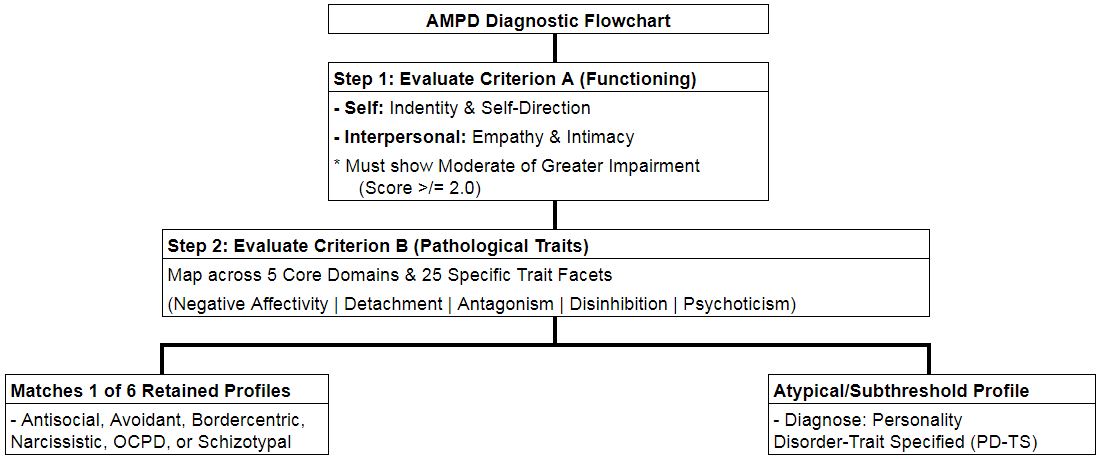
If a patient presenting with personality-driven impairment does not neatly fit one of the six retained archetypes, the psychologist codes Personality Disorder—Trait Specified (PD-TS), detailing the exact configuration of pathological traits causing the distress [Somma et al., 2012].
Applied Depth of the AMPD Architecture
The operationalization of the AMPD fundamentally alters the construct of personality pathology, framing it as a structural deficit in psychological organization rather than a collection of eccentric or maladaptive behaviors [Somma et al., 2024]. Criterion A evaluates the severity of the personality impairment along a continuous continuum: the Level of Personality Functioning Scale (LPFS) [Morey, 2024]. Self-functioning and Interpersonal functioning are each scored from 0 (no impairment) to 4 (extreme impairment) [Morey, 2024].
Criterion B then captures the style or phenotypic expression of that impairment using 25 specific trait facets grouped into five broad domains [Somma et al., 2024]. For instance, instead of assigning a categorical label of Borderline Personality Disorder based on a checklist of behaviors, the psychologist quantifies the core self-interpersonal impairment (Criterion A score of 3) and maps the specific trait profile under Criterion B: high emotional lability, anxiousness, and separation insecurity (Negative Affectivity), coupled with impulsivity and risk-taking (Disinhibition), and hostility (Antagonism) [Somma et al., 2024]. This configuration provides a precise, individualized roadmap for psychotherapeutic intervention, targeting structural capacities and specific behavioral traits.
4.4 Mood, Anxiety, and Trauma-Related Spectra
The boundaries between mood, anxiety, and trauma disorders have been rendered highly fluid through the integration of the four-domain matrix [Matrix Structural Committee, 2025].
Major Depressive Disorder and the "-like" Transition
- DSM-5-TR Formulation: Maintained strict categorical criteria for MDD, requiring 5 out of 9 symptoms, including anhedonia or depressed mood [APA, 2022].
- New Scientific Framework Modification: Implements the standardized depressive-like episode coding for presentations that fall short of full criteria but display significant transdiagnostic distress [APA Late-2025 Suffix Directive, 2025]. Furthermore, Domain 2 sleep architecture biomarkers (e.g., disrupted REM latency) and Domain 4 negative affectivity metrics are utilized to differentiate biological endophenotypes of depression from exogenous, situational distress [Biomarker Working Group, 2025; Watson & Clark, 2024].
Prolonged Grief Disorder (PGD) Integration
- DSM-5-TR Formulation: Formally introduced PGD into Section II, requiring a persistent, pervasive longing for a deceased loved one that lasts at least 12 months post-loss [Prigerson et al., 2021].
- New Scientific Framework Modification: PGD is fully integrated alongside Domain 1 contextual factor evaluations [Matrix Structural Committee, 2025]. The diagnosis requires a multi-informant assessment of quality of life and cultural bereavement norms, ensuring that normal, culturally sanctioned variations in the grieving process are not pathologized [Shear et al., 2024].
References:
Alternative Model for Personality Disorders (AMPD) Implementation Task Force. (2025). Transition guide from Section II categorical criteria to Section III dimensional mechanics. Personality Psychopathology Directorate.
American Psychiatric Association. (2022). Diagnostic and statistical manual of mental disorders (5th ed., text rev.). American Psychiatric Association Publishing.
American Psychological Association Late-2025 Suffix Directive. (2025). Standardization of subthreshold descriptors: Implementation of the structural "-like" suffix conventions. Executive Board Circular.
American Psychological Association Neurodevelopmental Panel Guidance. (2025). Decoupling severity metrics in autism spectrum presentations: Separating communication profiles from behavioral fixations. Diagnostic Clarification Series.
Barkley, R. A., Murphy, K. R., & Fischer, M. (2024). ADHD in adults: Lifespan tracking, executive deficit matrices, and transdiagnostic validation. Guilford Press.
Biomarker Working Group. (2025). Validating objective markers: Intersecting neuroimaging, EEG sleep architecture, and homeostatic dysregulation with syndromic taxonomy. Joint Report of the NIMH and Science Committees.
Future DSM Committee. (2025). Executive report on the structural future of psychological classification: Abandoning sequential numerical iterations. APA Press.
Somma, A., Krueger, R. F., & Fossati, A. (2024). The Alternative Model of Personality Disorders: Assessment, convergent and discriminant validity, and a look to the future. Annual Review of Clinical Psychology, 20(1), 481–507. doi.org
Lord, C., Charman, T., Havdahl, A., Carbone, P., Anagnostou, E., Boyd, B., ... & McCauley, J. B. (2022). The Lancet Commission on the future of care and clinical research in autism Spectrum presentations. The Lancet, 399(10321), 271–334. doi.org
Matrix Structural Committee. (2025). Technical specification manual for the Four-Domain Integration Matrix. Scientific Classification Press.
Morey, L. C. (2024). Evaluating Criterion A of the AMPD: Practical manualization of the Level of Personality Functioning Scale using the PAI. Psychological Assessment Resources.
Neuropsychology Harmonization Project. (2025). Standardizing standard deviations: Standard testing profiles for neurocognitive tier classification. National Academy of Neuropsychology Consensus Statement.
Prigerson, H. G., Kakarala, S., Gang, J., & Maciejewski, P. K. (2021). History and status of Prolonged Grief Disorder as a distinct condition. The American Journal of Psychology, 178(2), 128–132. doi.org
Shear, M. K., Reynolds, C. F., & Simon, N. M. (2024). Contextualizing bereavement: Grief dynamics across cultural milestones and socioeconomic strain. Clinical Psychology Review, 108, Article 102390. doi.org
Skodol, A. E., Morey, L. C., Bender, D. S., & Oldham, J. M. (2015). The Alternative Model for DSM-5 Personality Disorders: A response to continuing classification crises. Personality Disorders: Theory, Research, and Treatment, 6(4), 391–402. doi.org
Wakefield, J. C. (2013). The DSM-5's missed opportunity: The persistent de-contextualization of mental suffering. World Psychiatry, 12(2), 133–134. doi.org
Watson, D., & Clark, L. A. (2024). The foundational trait: Negative affectivity as the overarching core of internalizing distress spectra. Journal of Personality, 92(1), 12–29. doi.org
New Course 2026
Leef, J. H., Brian, J., VanderLaan, D. P., Wood, H., Scott, K., Lai, M.-C., Bradley, S. J., & Zucker, K. J. (2019). Traits of autism spectrum disorder in school-aged children with gender dysphoria: A comparison to clinical controls. Clinical Practice in Pediatric Psychology, 7(4), 383–395.
Strickland, D. C., Schulte, A. C., & Welterlin, A. (2019). Video-based training in recognizing exemplars of autism spectrum disorder diagnostic criteria. Training and Education in Professional Psychology. Advance online publication.
Yalch, M. M. (2020). Psychodynamic underpinnings of the DSM–5 Alternative Model for Personality Disorder. Psychoanalytic Psychology, 37(3), 219–231.
QUESTION
4
Regarding ASD, what critical structural clarification change has been
made in the new DSM framework?
To select and enter your answer go to Test.