MentalHealthCE Login


| Login | ||

Healthcare Training Institute - Quality Education since 1979
CE for Psychologist, Social Worker, Counselor, & MFT!!

Section 2
Structural Architecture
of the
Four-Domain Integration Matrix
Question 2 | Test | Table of Contents
The defining structural divergence of the new framework is the mandatory implementation of a Four-Domain Integration Matrix [Matrix Structural Committee, 2025]. Where the DSM-5 collapsed axes to create a non-axial, single-note diagnosis, the new scientific manual demands that a diagnostic formulation comprehensively profile four distinct, intersecting domains [Matrix Structural Committee, 2025].
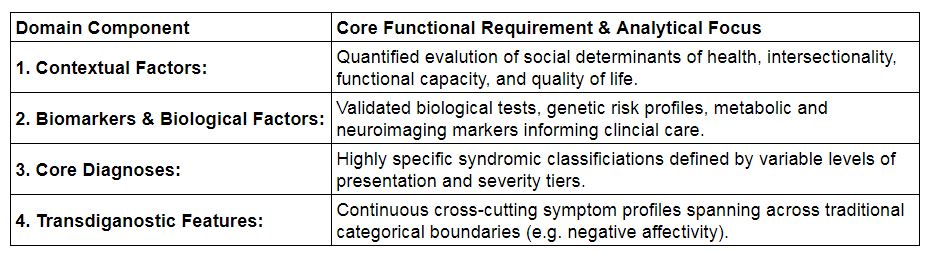
Comparative Structural Blueprint
To understand how clinical documentation shifts under this matrix, consider the comparative diagnostic structural profiles between the models [Practice Integration Blueprint, 2026]:
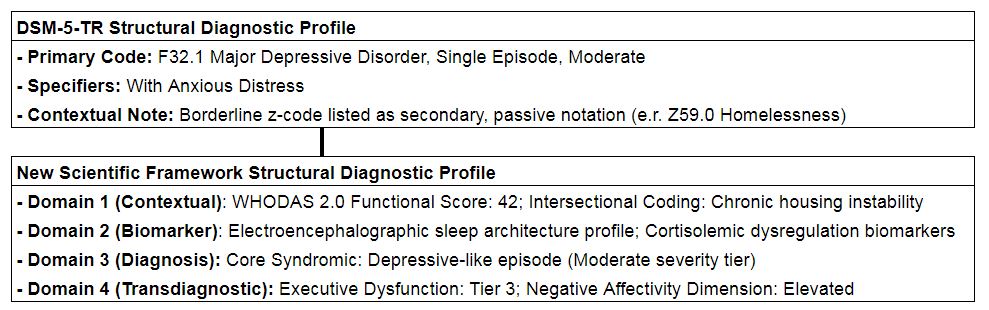
This structural architecture guarantees that no single dimension of a patient's presentation can be used to overshadow another [Matrix Structural Committee, 2025]. It mathematically patterns comorbidity not as an artificial expansion of co-occurring checklists, but as an expected intersection of core syndromic presentations and continuous transdiagnostic features [Kotov et al., 2017].
Domain 1: Contextual Factors, Functioning, and Quality of Life
The DSM-5 was heavily critiqued by the psychological community for its elimination of the multiaxial system (specifically Axis IV and V), which many argued de-contextualized psychopathology and stripped clinical documentation of vital systemic variables [Wakefield, 2013]. While the DSM-5-TR attempted to compensate by introducing an extensive review of the impact of racism, discrimination, and V/Z codes, these remained secondary, optional footnotes in daily medical billing.
Domain 1 of the new scientific framework elevates these variables to a position of equal weight in the diagnostic formulation [Matrix Structural Committee, 2025]. Rather than relying on simple, passive alphanumeric codes, it implements a formalized structure to measure social determinants of health (SDOH) alongside standardized instruments designed to directly quantify how a presentation impairs an individual's work, relationships, and daily activities [WHO, 2024]. A clinical diagnosis is no longer considered complete without an objective, multi-informant metric of the patient’s physical, emotional, and social well-being [Practice Integration Blueprint, 2026].
Deep-Dive Applied Mechanics of Domain 1
To fully conceptualize Domain 1, psychologists must understand the concept of allostatic load interaction [WHO Social Determinants Working Group, 2024]. Psychopathology does not occur in a vacuum; macro-systemic stressors (e.g., neighborhood safety, systemic economic marginalization, relational trauma history) structurally alter neuroendocrine pathways.
Domain 1 requires the clinician to administer standardized assessment blocks—primarily derived from updated versions of the World Health Organization Disability Assessment Schedule (WHODAS 2.0)—to establish a baseline functional impairment metric [WHO, 2024].
Instead of stating "the patient reports feeling stressed at work," the clinical note must mathematically plot the functional impairment across six primary sub-domains: Understanding and Communicating, Getting Around, Self-Care, Getting Along with People, Life Activities, and Participation in Society [WHO, 2024]. By linking this functional capacity metric directly to the primary core diagnosis, the framework prevents the misattribution of structural or environmental hardships to personal psychological failures [Practice Integration Blueprint, 2026].
References:
Kotov, R., Krueger, R. F., Watson, D., Achenbach, T. M., Althoff, R. R., Bagby, R. M., ... & Zimmerman, M. (2017). The Hierarchical Taxonomy of Psychopathology (HiTOP): A dimensional alternative to traditional nosologies. Journal of Abnormal Psychology, 126(4), 454–477. doi.org 10.1037/abn0000258
Matrix Structural Committee. (2025). Technical specification manual for the Four-Domain Integration Matrix. Scientific Classification Press.
Practice Integration Blueprint. (2026). Clinical workflow manual: Restructuring intake scripts and documentation fields for four-domain matrices. Psychological Practice Management Press.
Wakefield, J. C. (2013). The DSM-5's missed opportunity: The persistent de-contextualization of mental suffering. World Psychiatry, 12(2), 133–134. doi.org
World Health Organization. (2024). WHODAS 2.0 implementation guide for cloud-based outcome tracking platforms. WHO Press.
World Health Organization Social Determinants Working Group. (2024). Quantifying the intersectional matrix: Coding environment, economic stability, and systemic bias within healthcare data infrastructure. WHO Evaluation Series.
New Course 2026
Miller, J. D., Lamkin, J., Maples-Keller, J. L., Sleep, C. E., & Lynam, D. R. (2018). A test of the empirical profile and coherence of the DSM–5 psychopathy specifier. Psychological Assessment, 30(7), 870–881.
Sleep, C. E., Weiss, B., Lynam, D. R., & Miller, J. D. (2020). The DSM–5 section III personality disorder criterion a in relation to both pathological and general personality traits. Personality Disorders: Theory, Research, and Treatment, 11(3), 202–212.
Yalch, M. M. (2020). Psychodynamic underpinnings of the DSM–5 Alternative Model for Personality Disorder. Psychoanalytic Psychology, 37(3), 219–231.
QUESTION
2
What are the Four-Domain Integration Matrixes of the
new DSM framework?
To select and enter your answer go to Test.