MentalHealthCE Login


| Login | ||

Healthcare Training Institute - Quality Education since 1979
CE for Psychologist, Social Worker, Counselor, & MFT!!

Section
2
Clinical Somatic Exposures, Differential Mapping, and Workflow
Question 2 | Test | Table of Contents
1. Exposure-Based Interventions and Third-Wave Frameworks
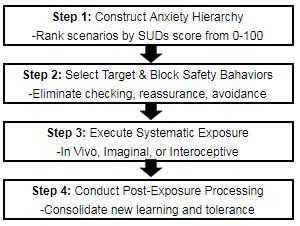
Exposure is the gold standard for reducing avoidance and facilitating inhibitory learning [Craske et al., 2014]. The process must be highly structured, collaborative, and deliberate.
- In Vivo Exposure
Direct, physical confrontation with the feared object or situation [Barlow, 2014]. Create a collaborative hierarchy using Subjective Units of Distress (SUDs) from 0 to 100, beginning with moderately distressing items. The client must remain in the situation until their expectancy of harm is disconfirmed, rather than simply waiting for distress to habituate [Craske et al., 2014].
- Imaginal Exposure
Vividly imagining the feared scenario in the present tense [Barlow, 2014]. This is ideal for GAD (worry exposure) where in vivo exposure is impossible. The clinician guides the client to describe the worst-case scenario in detail, incorporating sensory data and somatic responses until the script no longer triggers unmanageable distress.
- Interoceptive Exposure
Deliberate induction of feared bodily sensations [Barlow, 2014]. This is highly effective for panic disorder, where the client fears the physical symptoms of anxiety itself. Use physical exercises to mimic panic symptoms in a safe environment:
- Hyperventilation (60 seconds) to induce dizziness.
- Straw breathing (2 minutes) to induce shortness of breath.
- Running in place or star jumps to induce tachycardia.
Eliminating Safety Behaviors
Exposure will fail if the client uses safety behaviors, such as carrying anti-anxiety medication, relying on a companion, or using subtle distraction [Craske et al., 2014]. Clinicians must explicitly identify and block these behaviors during exposure to allow true inhibitory learning to occur [Craske et al., 2014].
Mindfulness, Acceptance, and Third-Wave Approaches
When anxiety cannot be easily restructured (such as real-world uncertainties in GAD), third-wave behavioral approaches like Acceptance and Commitment Therapy (ACT) are highly effective [Hayes et al., 2011].
- Cognitive Defusion: Teaching clients to view thoughts as language and mental events rather than absolute truths [Hayes et al., 2011]. Rapidly repeating a terrifying thought for 60 seconds or utilizing the phrase "I am having the thought that..." establishes critical psychological distance.
- Radical Acceptance: Encouraging clients to stop fighting reality or wasting energy trying to control uncontrollable variables [Hayes et al., 2011]. The goal changes from eliminating anxiety to living a rich, meaningful life while the anxiety is present.
2. Differential Diagnosis, Treatment Mapping, and Workflow
Anxiety disorders are highly comorbid with each other, as well as with depressive and trauma-related conditions [American Psychiatric Association, 2022]. Clinicians must follow a careful differential diagnosis process to avoid misclassification.
Suspected Primary Diagnosis |
Differential Diagnoses to Rule Out |
Key Clinical Distinguishing Factors |
Generalized Anxiety Disorder (GAD) |
Depressive Rumination; Obsessive-Compulsive Disorder (OCD) |
GAD worry is future-oriented, widespread, and lacks the ego-dystonic, repetitive rituals characteristic of OCD compulsions [American Psychiatric Association, 2022].
|
Panic Disorder |
Specific Phobia; Medical Conditions (Hyperthyroidism, Arrhythmia) |
Panic attacks in Panic Disorder occur unexpectedly ("out of the blue"), whereas phobic panic attacks are directly triggered by a specific stimulus [Barlow, 2014].
|
Social Anxiety Disorder (SAD) |
Agoraphobia; Avoidant Personality Disorder |
SAD focuses strictly on fear of social evaluation and scrutiny [American Psychological Association, 2022]. Agoraphobia focuses on safety and the inability to escape a physical space.
|
Steps for Step-by-Step Clinical Implementation
An effective treatment plan matches specific clinical interventions to the unique presentation of the diagnosis [Barlow, 2014; Hofmann et al., 2012].
-
Comprehensive Assessment: Administer standardized psychometric tools such as the Generalized Anxiety Disorder 7-item (GAD-7) scale or the Overall Anxiety Severity and Impairment Scale (OASIS) [American Psychiatric Association, 2022].
-
Psychoeducation: Demystify the anxiety response. Explain the evolutionary purpose of the fight-or-flight system and the role of avoidance in reinforcing the anxiety loop [Barlow, 2014].
-
Skill Acquisition: Train the client in cognitive restructuring, grounding techniques, or cognitive defusion before initiating exposure work [Hayes et al., 2011; Hofmann et al., 2012].
-
Targeted Exposure Work: Dedicate the mid-therapy sessions to intensive, structured exposure [Craske et al., 2014]. Ensure you allocate sufficient time for thorough processing after each exposure exercise.
-
Relapse Prevention: Collaborate with the client to create an anxiety management blueprint [Barlow, 2014]. This plan should clearly identify early warning signs of regression, outline core strategies learned, and define a clear plan for managing future setbacks.
-American Psychiatric Association. (2022). Diagnostic and statistical manual of mental disorders (5th ed., text rev.). American Psychiatry Publishing.
-
Barlow, D. H. (Ed.)(2014). Clinical handbook of psychological disorders: A step-by-step treatment manual (5th ed.). Guilford Press.
-
Craske, M. G., Treanor, M., Conway, C. C., Zbozinek, T., & Vervliet, B. (2014). Abstracting an inhibitory learning approach to exposure therapy. Behaviour Research and Therapy, 58, 10-23.
-Hayes, S. C., Strosahl, K. D., & Wilson, K. G. (2011). Acceptance and commitment therapy: The process and practice of mindful change (2nd ed.). Guilford Press.
-Hofmann, S. G., Asnaani, A., Vonk, I. J., Sawyer, A. T., & Fang, A. (2012). The efficacy of cognitive behavioral therapy: A review of meta-analyses. Cognitive Therapy and Research, 36(5), 427-440.
New Course 2026
Peer-Reviewed Journal Article References:
Booth, R. W., Erhan, K., Erkocaoğlan, O., Kuşpınar, H., & Yaldırak, K. (2025). The best possible self task has direct effects on expectancies and mood, and an indirect effect on anxiety symptom severity. Emotion, 25(4), 964–971. https://doi.org/10.1037/emo0001481
Gallagher, M. W., Phillips, C. A., D'Souza, J., Richardson, A., Long, L. J., Boswell, J. F., Farchione, T. J., & Barlow, D. H. (2020). Trajectories of change in well-being during cognitive behavioral therapies for anxiety disorders: Quantifying the impact and covariation with improvements in anxiety. Psychotherapy, 57(3), 379–390.
Joshi, Y. M., Milosevic, I., & Rowa, K. (2025). An investigation of internalized stigma in anxiety and related disorders. Stigma and Health. Advance online publication. https://doi.org/10.1037/sah0000669
Poetar, C.-R., Dobrean, A., & Florean, I. S. (2025). The Romanian version of the Youth Anxiety Measure for DSM-5: Reliability, validity, factor structure, and measurement invariance. European Journal of Psychological Assessment. Advance online publication. https://doi.org/10.1027/1015-5759/a000912
Stade, E. C., DeRubeis, R. J., Ungar, L., & Ruscio, A. M. (2023). A transdiagnostic, dimensional classification of anxiety shows improved parsimony and predictive noninferiority to DSM. Journal of Psychopathology and Clinical Science, 132(8), 937–948. https://doi.org/10.1037/abn0000863
Vidal-Arenas, V., Bravo, A. J., Ortet-Walker, J., Ortet, G., Ibáñez, M. I., & Mezquita, L. (2025). Longitudinal measurement invariance of the DSM-5 anxiety and depression severity measures. European Journal of Psychological Assessment, 41(3), 174–182. https://doi.org/10.1027/1015-5759/a000791
QUESTION 2
What are three ways to deliberately induce feared bodily sensations using Interoceptive Exposure?
To select and enter your answer go to Test.