MentalHealthCE Login


| Login | ||

Healthcare Training Institute - Quality Education since 1979
CE for Psychologist, Social Worker, Counselor, & MFT!!

Section 21
Coping
with Stress Violently
Question 21 | Test | Table of Contents
One concept that may provide an organizing principle for
many of the issues in violence prediction is that of stress. Stress can be understood
as a state of imbalance between the demands of the social and physical environment
and the capabilities of an individual to cope with these demands (McGrath 1970;
Mechanic 1968). The higher the ratio of demands to resources, the more stress
is experienced. Stress is thus to be thought of in terms of transactions between
persons and their environments over time (Lazarus and Launier, in press). The
voluminous literature on stress and its regulation has been masterfully systematized
by Novaco (1979), to which the reader is referred for further information. Novaco
presents a model of anger arousal as one form of reacting to stress, and his model,
with some modification, may provide a vehicle for explicating many (but not all)
of the factors to be assessed in violence prediction (cf. also Levinson and Ramsay
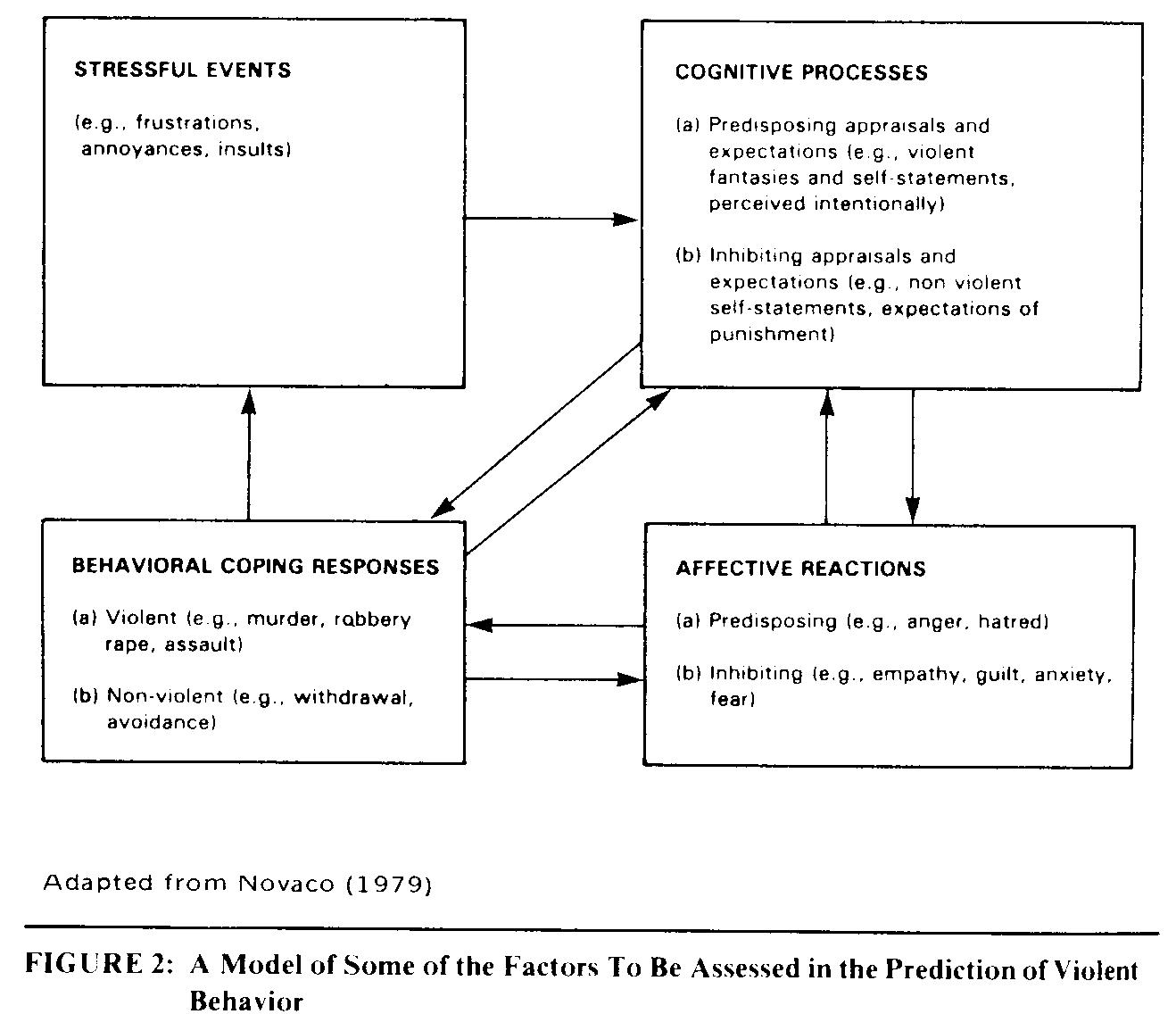
1979). It is presented in figure 2.
Stressful or aversive events such as frustrations, annoyances, insults, and assaults by another are seen in this model as filtered through certain cognitive processes in the individual who is the subject of assessment. Novaco conceptualizes these cognitive processes as being of two types: appraisals and expectations.
Appraisals refer to the manner in which an individual interprets an event as a provocation and therefore experiences it as aversive. Perceived intentionality is perhaps the clearest example of an antagonistic appraisal (e.g., "You didn't just bump into me, you meant to hit me"). How a person cognitively appraises an event may have a great influence on whether he or she ultimately responds to it in a violent manner. Some persons may be prone to interpret seemingly innocuous interactions as intentional slights. The chips on their shoulders may be precariously balanced.
Expectations are seen as cognitive processes that may influence
the occurrence of violence in several ways. If one expects a desired outcome (e.g.,
a raise in pay, an expression of gratitude for a favor done) and it fails to occur,
emotional arousal may ensue, and, depending upon the context, it may be perceived
as anger. If one appraises an event as a provocation, the occurrence of violence
may still depend upon whether one expects violence to be instrumental in righting
the perceived wrong or whether one can expect violence to be met with a counterforce.
One may, for example, regard having sand kicked in one's face as a deliberate
affront and yet, upon learning that the agent of provocation is built like a football
linebacker, have such low expectations for successful retaliation that violence
is no longer under consideration. Alternatively, should the provocateur resemble
Woody Allen, one's expectation that violence will prevail may rise accordingly.
Both expectations and appraisals may be reflected in the "private speech" or self-statements a person uses regarding violent behavior (e.g., "Anybody who insults my wife gets hit."). Violent delusions and fantasies may be thought of as extreme forms of such private conversations and statements of intention that are directly verbalized (i.e., threats of violence) may be particularly significant. For our purposes, appraisals and expectations may both be categorized as cognitive factors that "predispose" toward or "inhibit" violent behavior. These cognitive processes, in turn, may either give rise to certain affective or emotional reactions or may directly propel a behavioral response.
One need not be emotionally aroused to commit violent acts (e.g., the stereotypic "hitman" of Godfather fame). If, as is more typical, affective reactions are intervening, they may be viewed as either of a predisposing or an inhibiting type. Affective reactions predisposing a person toward violence would include the emotions of anger and hatred. While anger is not necessary for the occurrence of violent behavior, its arousal is a significant antecedent to aggression (Rule and Nesdale 1976). Fortunately, excellent work on the clinical assessment of anger is currently available (Novaco 1975, 1976, 1978, 1979). Affective reactions inhibiting violence (or, to put it more positively, predisposing toward peacefulness) include what have been called the "moral emotions" of empathy for the source of a frustration and guilt about injuring another, as well as anxiety reactions about engaging in violence or about the victim's possible retaliation. The lack of capacity for such affect has been viewed as the hallmark of the "sociopath" (Dinitz 1978).
In a state of alcohol or other drug-induced intoxication, many factors that ordinarily would serve to inhibit violence may be suppressed. The likelihood of such suppression should be estimated.
These affective reactions are then behaviorally expressed in terms of a coping response which, for our purposes, may be dichotomized as violent or nonviolent. The type of response chosen may go on to influence further stressful events, as would be the case when a divorce would eliminate interaction with a frustrating spouse or murder would precipitate the stresses of imprisonment. Whether or not a given coping response attenuates or exacerbates further life stresses would have relevance to whether a given level of violence potential could be expected to increase or decrease. As Toch (1969) emphasized, violence may be thought of as interactional in nature. If one person's coping response (e.g., insulting a person perceived as a threat) leads the other to escalate his or her provocations, violence may eventually ensue.
Several of the relationships expressed in figure 2 are bidirectional (as indicated by the arrows). This is meant to indicate that affective reactions can influence cognitive processes (e.g., "I feel so upset that I must be really angry") and that behavioral responses can affect both cognitions (e.g., "I hit him, therefore I must want to hurt him") and emotions (e.g., "I avoided her, therefore I must be angry at her").
The Novaco model of anger, as adapted here, is not exhaustive of the factors that influence violence. Demographic and historical factors, for example, are not addressed (hence, we inquire into them elsewhere in the assessment). But as a depiction of the cognitive and affective factors involved in violent behavior, the adapted Novaco model seems to capture well the essence of much of what must be assessed in violence prediction.
The kinds of stressors in which we are interested are those likely to be met with violent coping responses; While the kinds of stressors (e.g., frustrations, annoyances, insults, injuries) likely to result in violence are dependent upon the ways in which the individual cognitively and affectively processes them, and in fact may be thought of as fundamentally idiosyncratic in nature (see the next question), some general commonalities may exist among the kinds of situational demands likely to lead to violence. Based on the earlier analysis of the situational correlates of violent behavior (chapter 5), at least three broad areas of concern suggest themselves.
1. Family stressors. The frustrations and
annoyances attendant to husband-wife and parent-child relationships, as many
have
noted, appear particularly susceptible to violent resolution. An assessment of
the individual's current living situation
and the quality of social interactions
involved would appear to be a priority endeavor.
2. Peer group stressors. Analogous
to the family as a source of stress, the relationships of the individual to persons
he or she considers, or until recently has considered, friends may be germane.
In addition to disruption of friendship patterns being an instigator of stress,
the role of peers as models for violent behavior (Bandura 1973, 1969) and as sources
of social support for violent or nonviolent lifestyles (President's Commission
on Mental Health 1978) suggests that peer relations be carefully investigated.
3.
Employment stressors. While often overlooked, the stress associated with unemployment
or with aversive employment situations may have a significant effect upon criminal
behavior. These stressors may take the form of a recent firing, disputes with
superiors or co-workers, or dissatisfaction with the nature of the work performed
or the level of compensation paid for it.
- Monahan, John, Predicting Violent
Behavior: An Assessment of Clinical Techniques, Sage Publications: London, 1981.
How Can We Stop Our Children from Hurting Themselves?
Stages of Change, Motivational Interviewing, and Exposure Therapy
Applications for Non-suicidal Self-Injury in Children and Adolescents
- Kamen, David G. How Can We Stop Our Children from Hurting Themselves? Stages of Change, Motivational Interviewing, and Exposure Therapy Applications for Non-suicidal Self-Injury in Children and Adolescents. International Joural of Behavioral Consultation and Therapy, 5(1). p 106-123.
Personal
Reflection Exercise #7
The preceding section contained information
about coping with stress violently. Write three case study examples regarding
how you might use the content of this section in your practice.
Reviewed 2023
Update
Coping strategies and household stress/violence
in remote Alaska: a longitudinal view across the COVID-19 pandemic
- Fried, R., Hahn, M., Gillott, L., Cochran, P., & Eichelberger, L. (2022). Coping strategies and household stress/violence in remote Alaska: a longitudinal view across the COVID-19 pandemic. International journal of circumpolar health, 81(1), 2149064. https://doi.org/10.1080/22423982.2022.2149064
Peer-Reviewed Journal Article References:
Courtemanche, A. B., Piersma, D. E., & Valdovinos, M. G. (2019). Evaluating the relationship between the rate and temporal distribution of self-injurious behavior. Behavior Analysis: Research and Practice, 19(1), 72–80.
Ennis, C. R., Tock, J. L., Daurio, A. M., Raines, A. M., & Taylor, J. (2020). An initial investigation of the association between DSM–5 posttraumatic stress disorder symptoms and nonsuicidal self-injury functions. Psychological Trauma: Theory, Research, Practice, and Policy.
Fox, K. R., Harris, J. A., Wang, S. B., Millner, A. J., Deming, C. A., & Nock, M. K. (2020). Self-Injurious Thoughts and Behaviors Interview—Revised: Development, reliability, and validity. Psychological Assessment, 32(7), 677–689.
Raudales, A. M., Weiss, N. H., Goncharenko, S., Forkus, S. R., & Contractor, A. A. (2020). Posttraumatic stress disorder and deliberate self-harm among military veterans: Indirect effects through negative and positive emotion dysregulation. Psychological Trauma: Theory, Research, Practice, and Policy, 12(7), 707–715.
QUESTION
21
How does Monahan define the term "appraisal"? To select and enter your answer go to Test.