MentalHealthCE Login


| Login | ||

Healthcare Training Institute - Quality Education since 1979
CE for Psychologist, Social Worker, Counselor, & MFT!!

Section 18
Predictors of Self-Harm
Question 18 | Test | Table of Contents
The three studies that probably best estimated the extent to
which the gender of the individual may be a predictor of the occurrence of SIB
are the ones by Borthwick (1994), Borthwick et al. (1981), and Rojahn et al. (1999).
The first two were based on two different administrative data sets from California.
Rojahn et al. analyzed a combined California and New York data set. The prevalence
rates vary greatly across studies, and it seems that the global SIB prevalence
does not differ greatly between genders (see Table 3.4). The lower panel of Table
3.4 shows the relative prevalence of gender within the SIB samples. There does
seem to be a trend toward a higher representation of males in SIB samples, yet
that can easily be a function of uneven group sizes in the sampled population.
Comparisons of gender ratios within certain SIB topographies are not explored
here.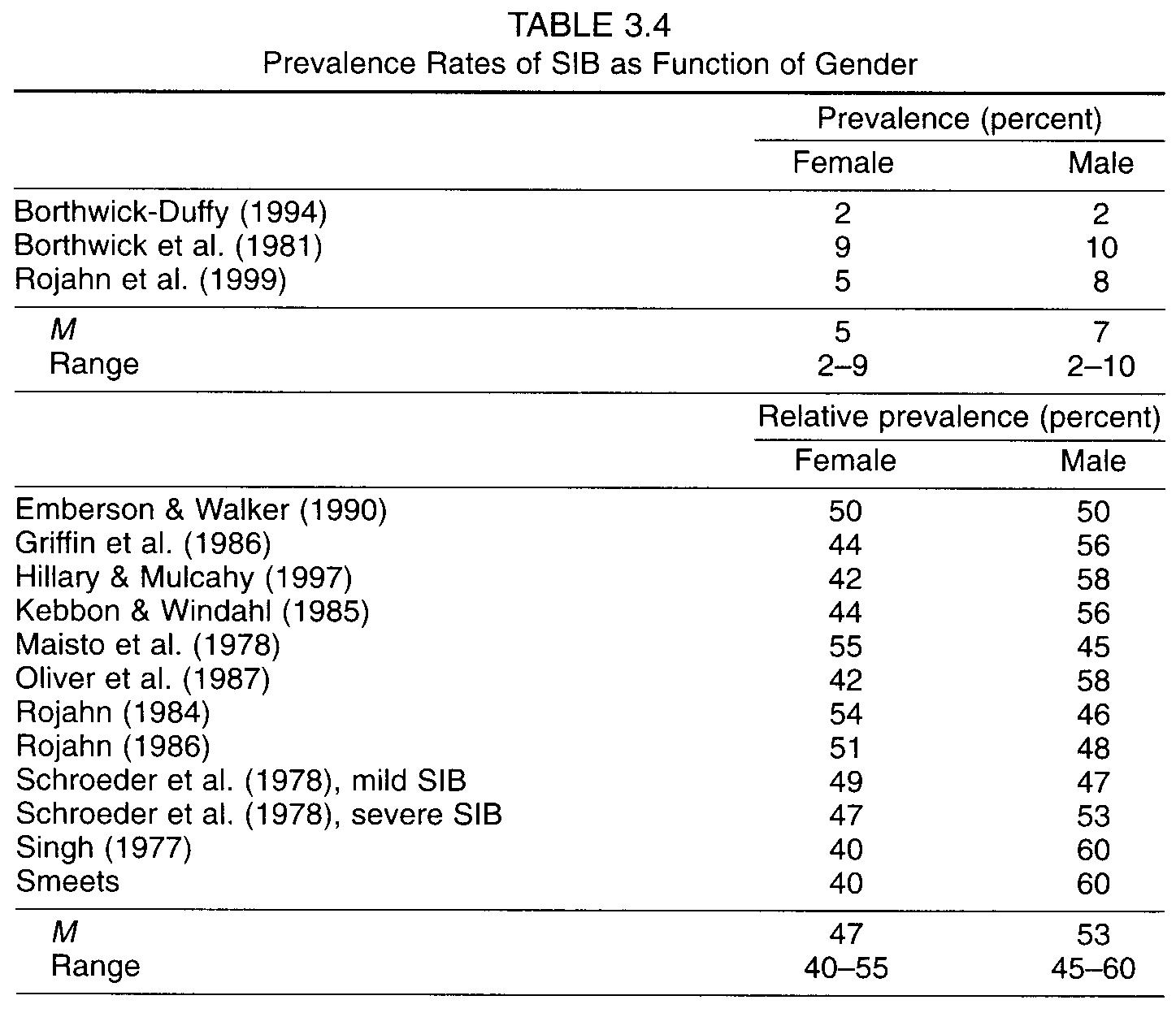
- Schroeder, Stephen, Oster-Granite, Mary, & Travis Thompson, Self-Injurious Behavior, American Psychological Association: Washington DC, 2002.
Personal
Reflection Exercise #4
The preceding section contained information
about global prevalence rate as a function of gender Write three case study examples
regarding how you might use the content of this section in your practice.
Reviewed 2023
Update
Predictors of repeated adolescent self-harm:
The display of multiple variables and mediators in a 2-year study
- Huang, Y. H., Liu, H. C., Sun, F. J., & Liu, S. I. (2022). Predictors of repeated adolescent self-harm: The display of multiple variables and mediators in a 2-year study. Journal of the Formosan Medical Association = Taiwan yi zhi, 121(12), 2584–2592. https://doi.org/10.1016/j.jfma.2022.08.019
Peer-Reviewed Journal Article References:
Adrian, M., Berk, M. S., Korslund, K., Whitlock, K., McCauley, E., & Linehan, M. (2018). Parental validation and invalidation predict adolescent self-harm. Professional Psychology: Research and Practice, 49(4), 274–281.
Courtemanche, A. B., Piersma, D. E., & Valdovinos, M. G. (2019). Evaluating the relationship between the rate and temporal distribution of self-injurious behavior. Behavior Analysis: Research and Practice, 19(1), 72–80.
Fox, K. R., Harris, J. A., Wang, S. B., Millner, A. J., Deming, C. A., & Nock, M. K. (2020). Self-Injurious Thoughts and Behaviors Interview—Revised: Development, reliability, and validity. Psychological Assessment, 32(7), 677–689.
MacMullin, L. N., Aitken, M., Nabbijohn, A. N., & VanderLaan, D. P. (2020). Self-harm and suicidality in gender-nonconforming children: A Canadian community-based parent-report study. Psychology of Sexual Orientation and Gender Diversity, 7(1), 76–90.
QUESTION
18
According to Schroeder, how did the prevalence rates of SIB compare
between genders? To select and enter your answer go to Test.